by Amanda Gay 2019
“A distinctive name”

We think it would be a suitable opportunity for commemorating the work of the Right Hon. Lord Reay, the chairman of the late authority, and we propose, therefore, that the new school shall be known as the ‘Reay’ L.C.C. school, Hackford-road.
And so, the first school planned and designed by the new London County Council was duly named after Lord Reay.

Donald Mackay, 11th Lord Reay was born in Holland. His father was a Scottish-Dutch MP and his mother was Dutch. He did not become British until 1877.
Lord Reay inherited his father’s title in 1876 at the age of 37. After that, he became Governor of Bombay and later a Government minister, before being appointed Chairman of the London School Board, from 1897 until its demise in 1904.

By 1904, school was compulsory for all 5-12 year olds, with provision to stay on to 13. Usually they learned basic skills, (the three ‘Rs’) plus domestic skills. Although some ‘higher elementary’ selective schools had started to appear in London, the School Board had no remit to spend ratepayers’ money on secondary education for poor children.
However, many pupils wanted to continue at school. Moreover, it was widely understood that new skills were needed to fit young people for employment in the new technological age.
Building the Reay school 1910

Reay Central Boys’ school was built in 1910. It was originally conceived as a mixed elementary school but actually opened as a ‘higher elementary’ or central school for 300 boys.The builders were Holliday and Greenwood, a Brixton firm.
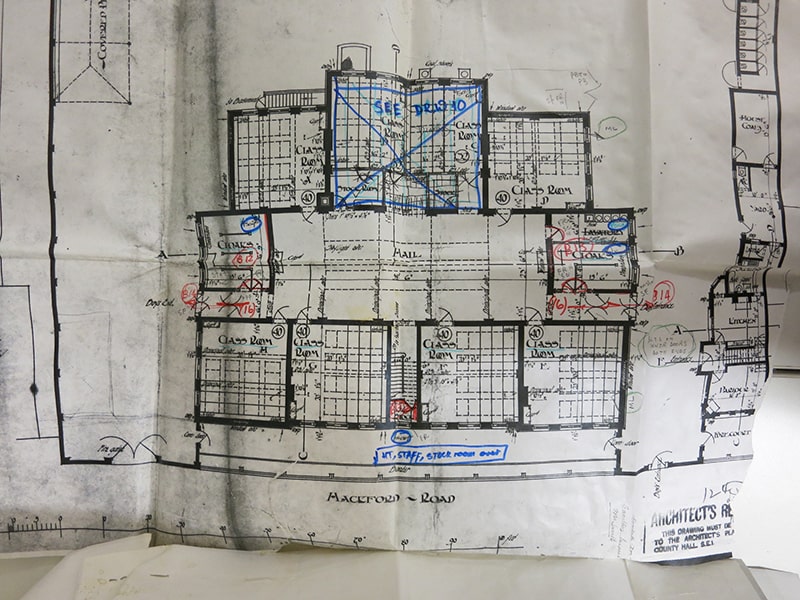
By October 1909, plans had been drawn and contractors engaged…
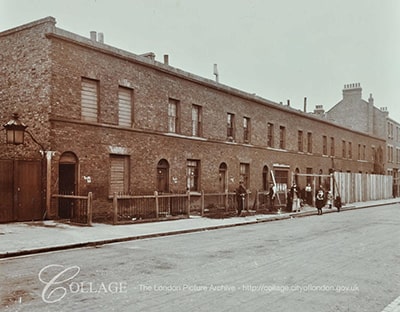
…12-28 Hackford Road (pictured) were demolished to make way for the school. Some tenants had to be ‘coaxed’ to leave.
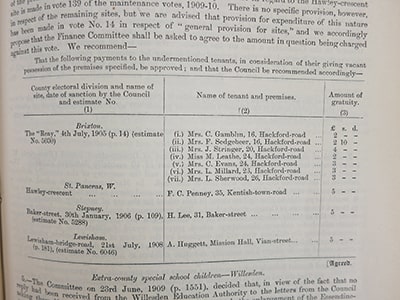
“Suitable in respect of personal character”
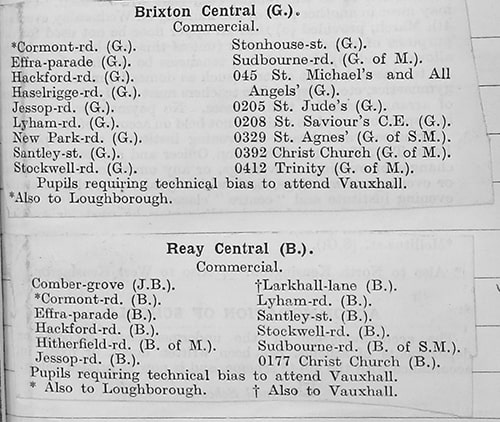
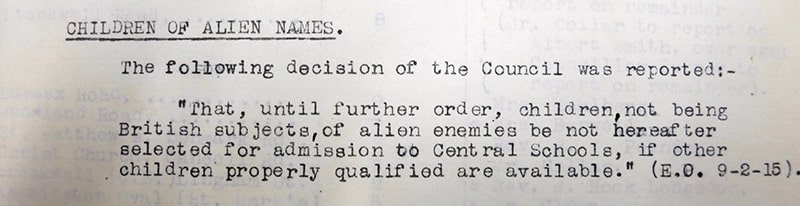
Central schools were city schools which selected pupils from surrounding elementary schools and taught them to a higher level. Selection for entry to the school was the responsibility of special committees, made up of one manager from each feeder school (shown below). Before a decision was made, one committee member visited each child at school and at home.
Other factors were also taken into consideration:
1915

1918

1938
The selection committee also chose which pupils were to be awarded a bursary (Junior County Exhibition) - of about £10 per year - in order to relieve their parents from the financial burden of keeping an employable child at school.
Only children whose family income was less than £160 pa could gain a JCE. Until 1918 the payments were graded according to need. and after that, major or minor awards were given.
The Reay school 1912 - 1939
The pictures on the right compare Reay Central Boys’ school in the 1920s-30s with the same view today. Above, the school athletes display their impressive trophies and below, senior boys watch a science demonstration.
The plans below show that a new science wing was built up the stairs on the left of the photographs in 1912. In addition to sport and science, the boys received a good general education with an emphasis on commercial skills like book-keeping. Boys desiring a technical training would have hoped to go to Vauxhall Central or the Beaufoy Institute nearby.

What the papers said about Reay
Goodwill Day 1931
In an event sponsored here in London by The Daily Herald and organised by the secretary of the National Union of Teachers, Edwin Dawson of Reay Central Boys’ school was one of five London school children chosen to exchange messages of peace by wireless (radio) and a transatlantic telephone call with other children in 20 countries around the world. Transatlantic telephone calls had only been commercially available since 1927. The pupils used the office of the Assistant Postmaster-General, at the House of Commons. Listening in were the President of the Board of Education and perhaps the Prime Minister, Ramsay MacDonald.
This annual event, begun in 1922 by Gwilym Davies, continues to the present day as a message of peace and goodwill from the young people of Wales. It marks the anniversary of the opening of the first Peace Conference at the Hague, Holland, on 18 May 1899.
What the papers said about Reay Central School
In the depths of the Great Depression, when even London had an unemployment rate approaching 14%, The Daily Herald reported that, although teenage school leavers found it easy to land a series of unskilled, badly paid jobs, it was much harder to gain one with future prospects.
Mr A Tasker, headmaster of Reay Central school, is quoted here as remarking that, because of the specialist (commercial) nature of teaching at Reay and its favourable reputation, finding suitable employment for school leavers had not been a problem in the past but that:
‘this year it has been more difficult’
“Villa upset by Hogan ‘find’ ” 1939
Reg Lewis is one of Arsenal’s all-time greats. So famous that he is one of thirty - two players depicted around the walls of the Emirates stadium.
Reg was born in Staffordshire in 1920 but went to Reay Central school until 1935 when he started playing for Arsenal, turning professional in 1937.
During his first 10 years at Arsenal, Reg’s average score rate was between one and two goals per match. However, goals scored during the war years do not count in league tables so he is listed as the twelfth highest scorer ever for the team. One of his finest hours was scoring two goals against Liverpool to win the FA Cup in April 1950 (pictured below)
Read more about Reg Lewis
watch the 1950 FA Cup Here
Holland Street PD School
LCC facsimile of final plans 1912, with additions
Holland Street special school was built by the London County Council in 1913.
Presiding at the grand opening ceremony in January 1914 was the chairman of the LCC education committee, alongside a range of local and international dignitaries.
The school provided for 80 disabled chidren and 45 older girls:
The new special school is a one-story building, designed to accommodate 125 …children. All the classrooms have a westerly aspect and are provided with casement doors opening directly into the playground, and protected from the weather by projecting eaves.
A teachers’ and a medical room, cloak-rooms and offices are features of the structure, and all are easily accessible from the playground. A play shed and small garden plots are in positions that will enable the children to profit by recreation or industry carried on in the open air
21-31 Holland Street, 1960s City of London Collage online image archive
1920 -1930s: LCC photos of Holland Street PD school, with similar views today
City of London Collage online image archive
Amalgamation
By 1950, Holland Street PD school had been renamed Caldwell Street PD school. The school continued into the 1960s, at which time the pupils were transferred to other special schools nearby and the buildings were incorporated into Reay Primary school, forming the Infant School wing. Two former pupils, Allan Stephenson and Avril Heron, have shared their memories with us. Allan wrote:
The classrooms opened on to the yard, which had a garden with a large tree to one end. Benches ran along the wall and at the narrow end one could re-enter the school, where there were rabbit and hamster hutches.
Does anyone remember the Special Needs needs school that was in Caldwell Street? I used to attend there every day. It was a Junior school and the headmistress was when I first went there a Miss Young. When she left Mrs Allan took over. There were ladies who attended on the green coaches which brought us all to school, a Mrs Taylor … a Mrs Ennis, Miss Aldrich.
Also, when I left there I went to Venetian Road school opposite Kings College hospital, which has also been pulled down.
Reay Primary School
Reay Central school pupils were evacuated along with 600,000 other London schoolchildren in September,1939.
Initially, London schools were sent to areas around the Home Counties: Reay Central went to Caversham, Berkshire. The Christmas party given there for all the children in December 1939 is the last mention of the school.
During the war years, the schooling of London children was problematic. Many schools were damaged by bombs. Evacuees trickled back to London before being sent even further away when the Blitz began. Returning children might find no school or no-one to teach them.
Reay Emergency School (girls) opened in March
1943. By July it had a roll of 224, with a waiting list. The girls were of Junior/Middle school age (8-11+). School, or at least admissions, continued throughout the summer of 1943. The pupils were returning from all over Britain - Cardiff, Devon, Dorset, Gateshead, Manchester, Olsworthy, Northumberland, Paisley; as well as from other local primary and infant schools.
A very small number of pupils were admitted throughout the 1940s from Reay Infants.
The school seems to have started taking boys in 1946, with about half the boys arriving from all over the country, as well as about half joining from Hackford Road school.
By the late 1940s the school had settled down, with regular arrivals aged eight and departures at eleven to local secondary, grammar and (a few) private schools.
In 1963 Reay was listed in LCC records as a primary JMI school for the first time. This probably reflected the acquisition of the Caldwell Street school site. During the 1970s, LCC architectural records show changes to the original plans of both schools and the two school buildings were successfully amalgamated.
LCC Architects made a record of the modernised buildings, which, together with other historic photos of the school and surrounding streets, are shown overleaf:
City of London Collage online image archive
1920 -1930s: LCC photos of Reay Central Boys’ and Holland Street PD schools
1960s:views of South Island place and Holland Street
South Island place: M Trace © London Borough of Lambeth; Holland Street: City of London Collage online image archive
Acknowledgements
I would like to end by thanking Caroline Andrews, headteacher, for her enthusiasm and vision with this project. At school, Luisa Ribeiro started the ball rolling, Tujia Sequeria unearthed school records, Nancy Headlam, Michael Field, Mike Chirambo and Jan Dusek have all been supportive.
Further afield, I have spent some hours at the London Metropolitan Archives, where all the records pertaining to London’s schools are stored. The associated online image archive, Collage, is a fascinating, easy to use source available to everyone.
Lambeth archives has an excellent online image archive, which is where I found old photographs of neighbouring streets, some looking almost the same as today and others greatly altered. Thanks are also due to the Arsenal Football Club for allowing their research and images to be used by community groups.
A final thanks to the very interesting reminiscences of former pupils Avril Heron and Allan Stephenson.
References
| Arsenal Football Club website | visit website |
| City of London Collage online picture archive | visit website |
| Education in England website | D Gillard visit website |
| Lambeth Archives: Lambeth Landmark | visit website |
| London County Council Education Records | 1905-1978 - read them at LMA |
| London Metropolitan Archives | visit website |
| Oval History website | visit website |
| Reay Primary School Archives | 1943-1960 |
| The British Library Board Newspaper Archive | visit website |
| The Daily Telegraph, 29 January 1914 | |
| The Vauxhall Society website | visit website |
Picture credits |
|
| Cover: Holland Street, later Caldwell St, in the Edwardian era. The school entrance is just past the dairy | |
| Any unlabelled photos are the author’s own. The portrait of Lord Reay is in the public domain | |
| All other images are clearly labelled with the details of the copyright holder. No unauthorised copying is allowed. | |
| Amanda Gay, January 2019 amandajgay@btinternet.com | |